*Required Field

This field is required.

Privacy Statement

When the goal is overall survival, give your AYA patients their best chance* with an asparaginase-containing regimen1,2

Treating AYA patients with asparaginase-containing regimens has shown improved overall survival3

In CALGB 10403, a prospective study, US cancer cooperative groups evaluated overall and event-free survival in AYA patients with ALL treated with a full pediatric regimen.3

*Compared with patient outcomes with hyper-CVAD.

Estimated 3-year overall survival in CALGB patients aged 16-39 years3

Asparaginase-intensive
CALGB 10403

(patients aged 17-39 years)

0 %

Adult 
regimen

(patients aged 16-29 years)

0 %

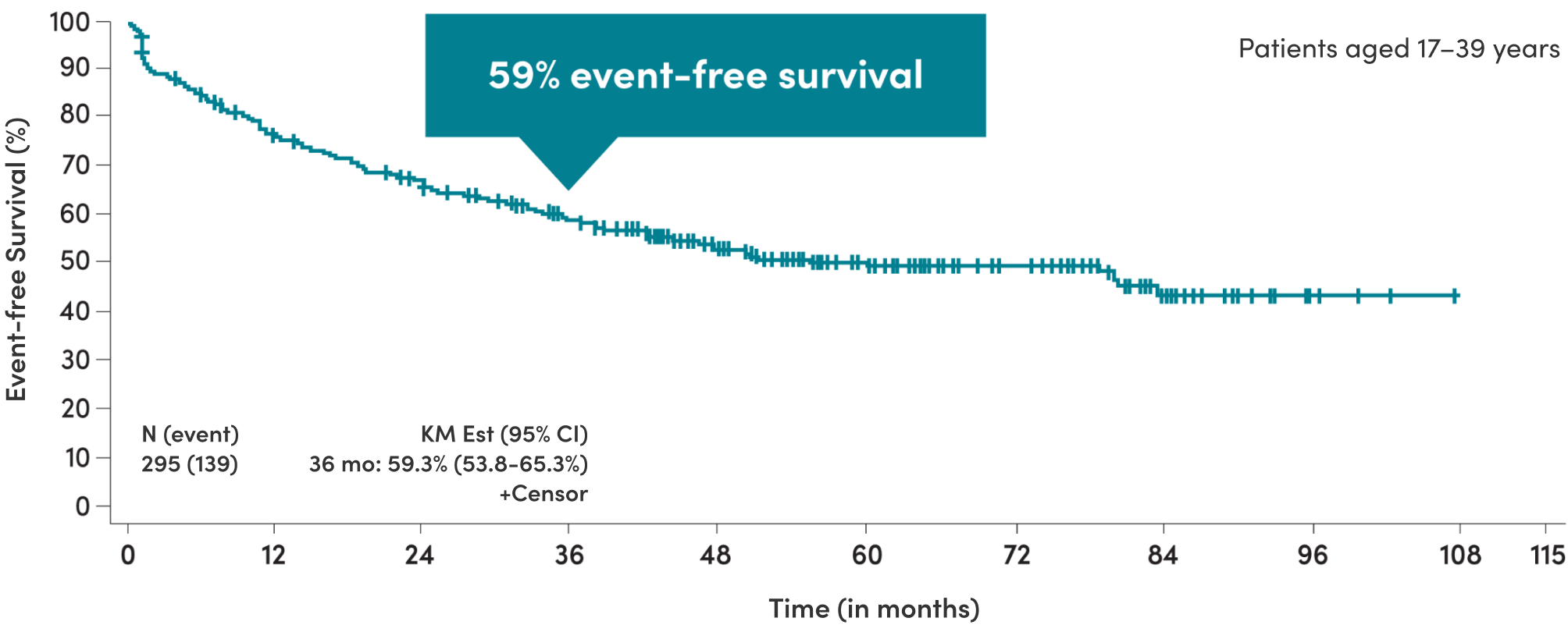
Regimens containing asparaginase provided ~6.5 years of median event-free survival in AYA patients3

In CALGB 10403, median event-free survival in AYA patients was 78.1 months (95% CI: 41.8-NE months) compared to 30 months with historical controls (95% CI: 22-38 months)3

Historical controls consisted of patients with newly diagnosed, non-PH+ ALL age 16 to 29 who were enrolled in previous CALGB trials.3

3-year event-free survival for ALL patients treated with pediatric CALGB 10403 regimen containing asparaginase3
3-year Event-Free Survival for ALL Patients Chart

Adapted from Stock et al, 2019.3


The Stock study determined that the CALGB 10403 regimen containing asparaginase was considered safe. Of the 295 evaluable AYA patients, there were 8 (3%) treatment-related deaths: 6 occurred during the induction course and 2 post-remission.3

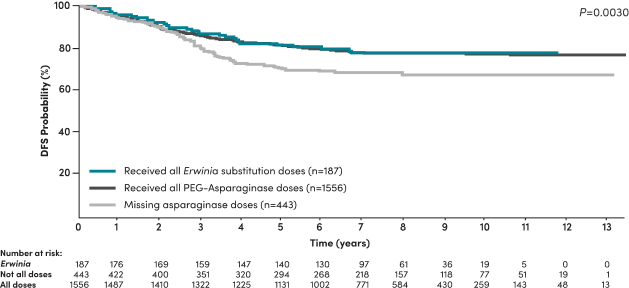
Patients who missed asparaginase doses had inferior disease-free survival (DFS)4

A 2020 study by Gupta et al in high-risk B-ALL COG patients demonstrated4:

  • Significantly inferior DFS was seen in patients who did not receive all prescribed asparaginase doses
  • Asparaginase missed doses is a predictor of DFS among patients, even when adjusted for other risk factors such as age, cytogenetics, time to response, WBC count, and CNS status
  • Missing asparaginase doses increased the risk of an event by 50% (HR=1.5, 95% CI: [1.1-1.9], P=0.002)§
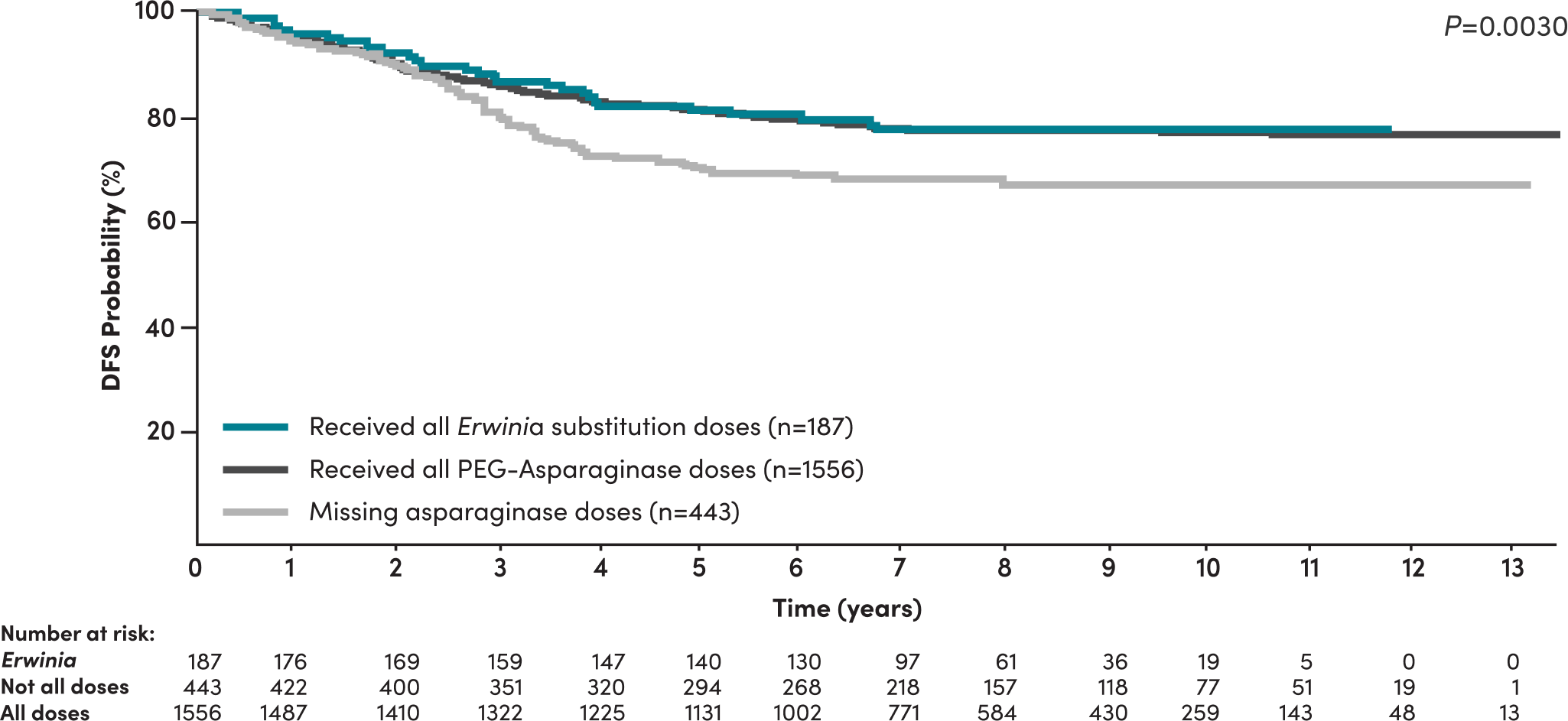
DFS of NCI high-risk patients stratified by asparaginase received4
Years since diagnosis chartYears since diagnosis chart

Commit to asparaginase completion

Patients receiving all Erwinia substitution doses achieved similar DFS compared to patients receiving all pegaspargase doses4

Event defined as DFS from time of maintenance initiation to relapse, death, development of a second malignant neoplasm, or last follow-up.4

§Patients with NCI high-risk B-ALL.4

A comprehensive 8-year (2004-2011) study including over 8300 patients, in partnership with the COG.4

The study included newly diagnosed B-ALL patients aged 1-31 years who were enrolled in 1 of 2 COG clinical trials. This included 5195 patients within the COG study AALL0331 (NCI SR B-ALL, age >1 and <10 years, initial WBC count <50,000/μL; 2005-2010) and 3001 patients within AALL0232 (NCI high-risk B-ALL, aged 10-30 years or initial WBC count ≥50,000/μL and any age; 2004-2011, or NCI SR with testicular disease or some patients with steroid pretreatment).4

This landmark survival analysis was for the 2,186 NCI high-risk patients who started maintenance. DFS was defined as time from maintenance initiation to relapse, death, development of a second malignant neoplasm, or last follow-up.4

In high-risk patients who did not receive all prescribed asparaginase doses (n=443), 99 (22.3%) had an event, including 95 (21.3%) with relapse, 2 (0.4%) with second malignant neoplasms, and 2 (0.4%) who died off therapy as a first event.4

There were several study limitations, including (but not limited to)4:

  • Exact number of missed pegaspargase doses could not be determined
  • Generalizability of our results to patients with T-ALL is unknown

Switching to an asparaginase with minimal immunologic cross-reactivity can help preserve patient outcomes5

  • Compared to those who experienced hypersensitivity and subsequently missed doses, higher risk (high-risk + slow early responders for SR) patients who switched to an Erwinia-derived asparaginase therapy due to hypersensitivity were at lower risk of relapse and had higher rates of DFS4
  • Rechallenging patients can compromise their outcomes and further expose them to hypersensitivity6,7
 

When hypersensitivity threatens patient outcomes, consider switching to an immunologically distinct asparaginase8
 
Medication Icon

Help protect patient outcomes

RYLAZE is the only FDA-approved Erwinia asparaginase for the treatment of ALL/LBL for patients who develop hypersensitivity to E. coli asparaginase9

WHY RYLAZE? >

Indication

RYLAZE is indicated as a component of a multi-agent chemotherapeutic regimen given by intramuscular injection for the treatment of acute lymphoblastic leukemia (ALL) and lymphoblastic lymphoma (LBL) in adult and pediatric patients 1 month or older who have developed hypersensitivity to E. coli-derived asparaginase.

IMPORTANT SAFETY INFORMATION

Contraindications

RYLAZE is contraindicated in patients with:

  • History of serious hypersensitivity reactions to Erwinia asparaginase, including anaphylaxis
  • History of serious pancreatitis during previous asparaginase therapy
  • History of serious thrombosis during previous asparaginase therapy
  • History of serious hemorrhagic events during previous asparaginase therapy
  • Severe hepatic impairment

Warnings and Precautions

Hypersensitivity Reactions

Hypersensitivity reactions after the use of RYLAZE occurred in 29% of patients in clinical trials, and it was severe in 6% of patients. Anaphylaxis was observed in 2% of patients after intramuscular administration. Discontinuation of RYLAZE due to hypersensitivity reactions occurred in 5% of patients. Hypersensitivity reactions were higher in patients who received intravenous asparaginase erwinia chrysanthemi (recombinant)-rywn. The intravenous route of administration is not approved.

In patients administered RYLAZE intramuscularly in clinical trials, the median number of doses of RYLAZE that patients received prior to the onset of the first hypersensitivity reaction was 12 doses (range: 1-64 doses). The most commonly observed reaction was rash (19%), and 1 patient (1%) experienced a severe rash.

Hypersensitivity reactions observed with L-asparaginase class products include angioedema, urticaria, lip swelling, eye swelling, rash or erythema, blood pressure decreased, bronchospasm, dyspnea, and pruritus.

Premedicate patients prior to administration of RYLAZE as recommended. Because of the risk of serious allergic reactions (e.g., life-threatening anaphylaxis), administer RYLAZE in a setting with resuscitation equipment and other agents necessary to treat anaphylaxis (e.g., epinephrine, oxygen, intravenous steroids, antihistamines). Discontinue RYLAZE in patients with serious hypersensitivity reactions.

Pancreatitis

Pancreatitis, including elevated amylase or lipase, was reported in 20% of patients in clinical trials of RYLAZE and was severe in 8%. Symptomatic pancreatitis occurred in 7% of patients, and it was severe in 6% of patients. Elevated amylase or lipase without symptomatic pancreatitis was observed in 13% of patients treated with RYLAZE. Hemorrhagic or necrotizing pancreatitis have been reported with L-asparaginase class products.

Inform patients of the signs and symptoms of pancreatitis, which, if left untreated, could be fatal. Evaluate patients with symptoms compatible with pancreatitis to establish a diagnosis. Assess serum amylase and lipase levels in patients with any signs or symptoms of pancreatitis. Discontinue RYLAZE in patients with severe or hemorrhagic pancreatitis. In the case of mild pancreatitis, withhold RYLAZE until the signs and symptoms subside and amylase and/or lipase levels return to 1.5 times the ULN. After resolution of mild pancreatitis, treatment with RYLAZE may be resumed.

Thrombosis

Serious thrombotic events, including sagittal sinus thrombosis and pulmonary embolism, have been reported in 1% of patients following treatment with RYLAZE. Discontinue RYLAZE for a thrombotic event, and administer appropriate antithrombotic therapy. Consider resumption of treatment with RYLAZE only if the patient had an uncomplicated thrombosis.

Hemorrhage

Bleeding was reported in 25% of patients treated with RYLAZE, and it was severe in 2%. Most commonly observed reactions were bruising (12%) and nose bleed (9%).

In patients treated with L-asparaginase class products, hemorrhage may be associated with increased prothrombin time (PT), increased partial thromboplastin time (PTT), and hypofibrinogenemia. Consider appropriate replacement therapy in patients with severe or symptomatic coagulopathy.

Hepatotoxicity, including Hepatic Veno-Occlusive Disease

Elevated bilirubin and/or transaminases occurred in 75% of patients treated with RYLAZE in clinical trials, and 26% had Grade ≥3 elevations. Elevated bilirubin occurred in 28% of patients treated with RYLAZE in clinical trials, and 2% had Grade ≥3 elevations. Elevated transaminases occurred in 73% of patients treated with RYLAZE in clinical trials, and 25% had Grade ≥3 elevations.

Hepatotoxicity, including severe, life-threatening, and potential fatal cases of hepatic veno-occlusive disease (VOD), have been observed in patients treated with asparaginase class products in combination with standard chemotherapy, including during the induction phase of multiphase chemotherapy. Do not administer RYLAZE to patients with severe hepatic impairment. Inform patients of the signs and symptoms of hepatotoxicity.

Evaluate bilirubin and transaminases prior to each cycle of RYLAZE and at least weekly during cycles of treatment that include RYLAZE, through four weeks after the last dose of RYLAZE. Monitor frequently for signs and symptoms of hepatic VOD, which may include rapid weight gain, fluid retention with ascites, hepatomegaly (which may be painful), and rapid increase of bilirubin. For patients who develop abnormal liver tests after RYLAZE, more frequent monitoring for liver test abnormalities and clinical signs and symptoms of VOD is recommended. In the event of serious liver toxicity, including VOD, discontinue treatment with RYLAZE and provide supportive care.

Adverse Reactions

The most common adverse reactions (incidence >20%) with RYLAZE are abnormal liver test, nausea, musculoskeletal pain, infection, fatigue, headache, febrile neutropenia, pyrexia, hemorrhage, stomatitis, abdominal pain, decreased appetite, drug hypersensitivity, hyperglycemia, diarrhea, pancreatitis, and hypokalemia.

Use in Specific Populations

Pregnancy and Lactation

RYLAZE can cause fetal harm when administered to a pregnant woman. Advise females of reproductive potential to use effective non-hormonal contraceptive methods during treatment with RYLAZE and for 3 months after the last dose. Advise women not to breastfeed during treatment with RYLAZE and for 1 week after the last dose.

Please see full Prescribing Information.

ALL=acute lymphoblastic lymphoma; AYA=adolescent and young adult; B-ALL=B-cell acute lymphoblastic leukemia; CALGB=Cancer and Lymphoma Group B; CI=confidence interval; CNS=central nervous system; COG=Children’s Oncology Group; E. coli=Escherichia coli; FDA=Food and Drug Administration; HR=hazard ratio; LBL=lymphoblastic leukemia; NCI=National Cancer Institute; non-PH+ ALL=non-Philadelphia chromosome acute lymphoblastic leukemia; NR=not reached; PEG=polyethylene glycol; SR=standard risk; T-ALL=T-cell acute lymphoblastic leukemia; WBC=white blood cell.

References: 1. Siegel SE, Advani A, Seibel N, et al. Treatment of young adults with Philadelphia-negative acute lymphoblastic leukemia and lymphoblastic lymphoma: hyper-CVAD vs. pediatric-inspired regimens. Am J Hematol. 2018;93(10):1254-1266. 2. Juluri KR, Siu C, Cassaday RD. Asparaginase in the treatment of acute lymphoblastic leukemia in adults: current evidence and place in therapy. Blood Lymphat Cancer. 2022;12:55-79. 3. Stock W, Luger SM, Advani AS, et al. A pediatric regimen for older adolescents and young adults with acute lymphoblastic leukemia: results of CALGB 10403. Blood. 2019;133(14):1548-1559. 4. Gupta S, Wang C, Raetz EA, et al. Impact of asparaginase discontinuation on outcome in childhood acute lymphoblastic leukemia: a report from the Children’s Oncology Group. J Clin Oncol. 2020;38(17):1897-1905. 5. Maese L, Loh ML, Choi RM, et al. Recombinant Erwinia asparaginase (JZP458) in ALL/LBL: complete follow-up of the Children’s Oncology Group AALL1931 study. Blood Adv. 2025;9(1):66-77. 6. Liu Y, Smith CA, Panetta JC, et al. Antibodies predict pegaspargase allergic reactions and failure of rechallenge. J Clin Oncol. 2019;37(23):2051-2061. 7. Swanson HD, Panetta JC, Barker PJ, et al. Predicting success of desensitization after pegaspargase allergy. Blood. 2020;135(1):71-75. 8. Asselin B. Immunology of infusion reactions in the treatment of patients with acute lymphoblastic leukemia. Future Oncol. 2016;12(13):1609-1621. 9. RYLAZE [package insert]. Palo Alto, CA: Jazz Pharmaceuticals, Inc.

Indication

RYLAZE is indicated as a component of a multi-agent chemotherapeutic regimen given by intramuscular injection for the treatment of acute lymphoblastic leukemia (ALL) and lymphoblastic lymphoma (LBL) in adult and pediatric patients 1 month or older who have developed hypersensitivity to E. coli-derived asparaginase.

IMPORTANT SAFETY INFORMATION

IMPORTANT SAFETY 
INFORMATION AND INDICATION

Contraindications

RYLAZE is contraindicated in patients with:

  • History of serious hypersensitivity reactions to Erwinia asparaginase, including anaphylaxis
  • History of serious pancreatitis during previous asparaginase therapy
  • History of serious thrombosis during previous asparaginase therapy
  • History of serious hemorrhagic events during previous asparaginase therapy
  • Severe hepatic impairment